What is Backtesting in Trading? A Complete Guide (2026)
Retail trading is full of expensive guesswork. You see a moving average crossover on a chart, notice it worked the last three times, and assume you have an edge. Then you trade it with real money, hit a flat market, and blow up your account.
If you want to survive the Indian stock market long enough to actually build wealth from it, you need to stop guessing. You need backtesting.
What is Backtesting in Trading?
Backtesting is the process of applying a specific, mechanical set of trading rules to historical market data to see how that strategy would have performed in the past. It replaces intuition with evidence.
Instead of asking, "Does the Supertrend indicator work today?" you ask a computer, "If I bought every Supertrend buy signal on the Nifty 50 for the last five years, how much money would I have made or lost, and how bad would the worst drawdown have been?"
The math doesn't lie. If a strategy failed to make money during the 2020 crash or the 2022 chop, it will likely fail you again under similar conditions — no matter how convincing it looks on a three-month chart.
How Backtesting Actually Works
A proper backtest has four stages:
- Define the rules. Entry trigger, exit trigger, position sizing, and the universe of stocks or instruments — written down as exact, numeric conditions with no room for interpretation.
- Gather clean historical data. Price, volume, and — critically — a complete list of the instrument's constituents at the time, including stocks that have since been delisted or removed from an index. More on why this matters below.
- Simulate the trades. Run the rules against the historical data, trade by trade, applying realistic transaction costs, slippage, and execution assumptions.
- Evaluate the results. Look past the headline return number and into the metrics that actually tell you whether the strategy is robust or just lucky.
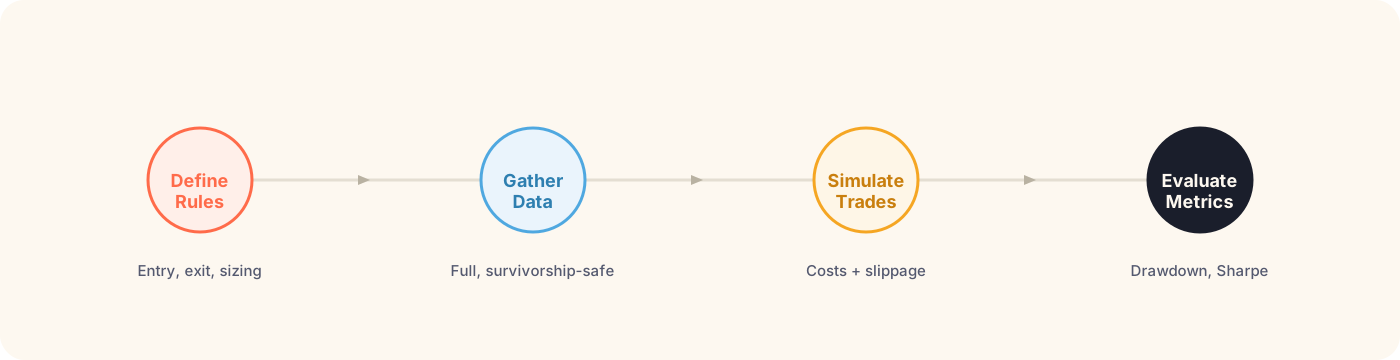
The four stages of a proper backtest, from rule definition to evaluation.
The Metrics That Actually Matter
A single "total return" number tells you almost nothing about whether a strategy is safe to trade. Look at these instead:
- Win rate — the percentage of trades that were profitable. Useful, but meaningless without knowing the average win/loss size.
- Max drawdown — the largest peak-to-trough decline in the equity curve. This is the number that tells you what it would actually feel like to trade this strategy through its worst stretch.
- Sharpe ratio — return adjusted for volatility. A strategy that makes 20% a year with wild swings can be objectively worse than one that makes 12% smoothly.
- Profit factor — gross profit divided by gross loss. A profit factor above 1.5 is generally considered healthy; below 1.2 leaves very little margin for real-world friction like slippage.
- Number of trades — a backtest built on 15 trades over five years hasn't demonstrated an edge; it's demonstrated a coincidence. You need a large enough sample to trust the result.
Common Mistakes That Make Backtests Lie to You
This is the part most beginner backtests get wrong, and it's the difference between a strategy that works live and one that quietly drains your account.
- Survivorship bias — testing only on stocks that are currently in an index, ignoring every stock that was delisted or dropped out along the way. This silently deletes your worst historical trades from the dataset and makes every strategy look better than it actually was.
- Lookahead bias — accidentally using information in your simulation that wouldn't have been available at the time of the trade, like using a day's closing price to decide whether to enter earlier that same day.
- Overfitting / curve fitting — tuning your rules until they perfectly explain historical price action. A strategy with 9 parameters tuned to 3 years of data isn't a trading edge, it's a description of the past.
- Ignoring transaction costs — brokerage, STT, and slippage matter enormously for high-frequency or small-cap strategies. A strategy that looks profitable before costs can be a consistent loser after them.
- No out-of-sample testing — building and validating your rules on the exact same stretch of data. Always hold back a period the strategy has never "seen" and check whether the edge survives.
Backtesting vs. Paper Trading vs. Live Trading
These three are often confused, but they test different things:
- Backtesting validates a strategy against years of historical data in seconds — the fastest way to reject a bad idea before it costs you money.
- Paper trading (forward testing without real capital) validates that your execution process — order entry, timing, discipline — actually works in current, live market conditions.
- Live trading is the final test, and the only one with real financial and psychological stakes attached.
Skipping straight to live trading without the first two steps means you're paying full price to find out what a backtest would have told you for free.
Do You Need to Know How to Code to Backtest a Strategy?
Historically, yes — backtesting meant writing Python scripts to pull historical data, simulate trades, and calculate metrics yourself, which put it out of reach for most retail traders. That's changed. No-code backtesting tools now let you define entry and exit rules through a visual interface and run them against years of historical Nifty and Sensex data without writing a single line of code.
Frequently Asked Questions
How much historical data do I need to backtest a strategy? As a general rule, test across multiple different market regimes — at least one strong bull run, one sideways/choppy period, and one sharp correction. A strategy that's only been tested on a bull market hasn't really been tested at all.
Can a backtest guarantee future performance? No. A backtest tells you how a strategy would have performed under past conditions, not what will happen in the future. What it does give you is evidence of a repeatable, rules-based edge — which is a meaningfully better starting point than a hunch.
What's a "good" backtest result? There's no single number, but a strategy with a healthy profit factor, a manageable max drawdown you could actually stomach living through, a reasonable number of trades, and performance that holds up in out-of-sample testing is far more trustworthy than one judged on total return alone.
Test Your Own Ideas Against Real Data
Reading about backtesting is useful. Running your own strategy against five years of real Nifty and Sensex data is what actually tells you whether you have an edge. Build and backtest your first strategy in MilesBT — no Python required.
Validate this strategy yourself
Stop relying on rules of thumb. Test indicators and custom swing setups against 5+ years of verified Indian market data on MilesBT.
Open Backtest Builder