How to Backtest a Trading Strategy Without Coding (Step-by-Step)
For years, backtesting meant learning Python, wrestling with data files, and debugging your own simulation code before you could test a single idea. That kept most retail traders guessing. Today you can backtest a trading strategy without writing a line of code, but the tool is the easy part. The hard part is running the test in a way that tells you the truth. This guide walks through the process step by step, so the result you get is one you can actually trust.
If you're new to the concept, start with what backtesting is and why it matters, then come back here for the hands-on process.
Step 1: Write Your Rules in Plain English First
Before you open any tool, write your strategy as a short list of exact rules. Every rule must be something a computer could check without judgment:
- Universe: Which stocks or index are you trading? (For example, the Nifty 50.)
- Entry: What exact condition triggers a buy? (For example, close above the 20-day EMA and RSI above 50.)
- Exit: What closes the trade? A stop loss, a target, a trailing stop, or a maximum holding period.
- Position size: How much capital or risk goes into each trade?
If you can't write a rule without words like "strong," "looks good," or "about," it isn't testable yet. Tighten it until it is. The guide on building a swing trading strategy covers how to turn a vague idea into measurable rules.
Step 2: Choose Your Universe and Time Period
Pick the instruments and the date range you'll test against. Two rules of thumb:
- Cover multiple market regimes. Your test period should include a trending stretch, a choppy sideways stretch, and at least one sharp correction. A strategy tested only on a bull run has not really been tested.
- Keep the universe realistic. Only include stocks you could actually have traded, with enough liquidity to absorb your order size. A strategy that "works" on illiquid names often can't be executed in real life.
Also be careful about survivorship bias: if your test only includes stocks that exist today, it silently removes every company that failed along the way, which flatters almost every strategy.
Step 3: Set Realistic Costs and Slippage
This is the step beginners skip, and it's the one that separates a backtest that looks great from one that survives contact with a real brokerage account. Include:
- Brokerage charges
- Securities Transaction Tax (STT), exchange charges, GST, and stamp duty
- Slippage, the gap between the price you expected and the price you actually got
A strategy that trades frequently or in less liquid stocks can turn from profitable to losing once these are included. If a tool lets you switch costs off, leave them on.
Step 4: Run the Backtest
With rules, universe, period, and costs set, run the simulation. In a visual, no-code backtester, this means building your entry and exit conditions through the interface and letting the engine simulate every trade across the full history. It's the same process a coded backtest follows, without the scripting.
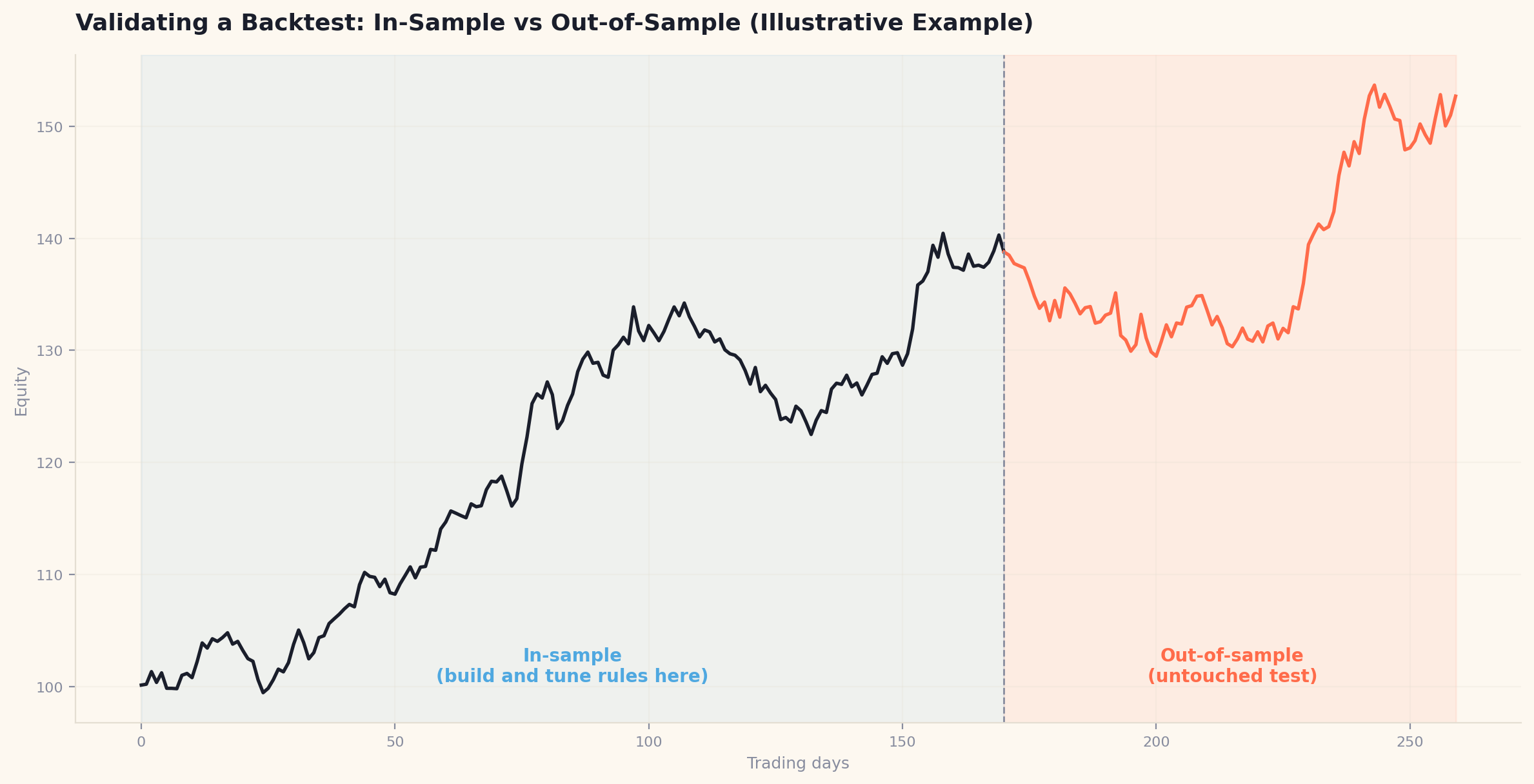
Illustrative example: build and tune your rules on one section of history, then confirm them on a section the strategy has never seen. Not real market data.
Step 5: Read the Results Beyond Total Return
Don't stop at the headline profit number. Check:
- Max drawdown: the worst peak-to-trough decline. Could you have stayed disciplined through it?
- Sharpe ratio: return relative to the volatility it took to earn it.
- Profit factor: gross profit divided by gross loss. Values barely above 1 leave no room for real-world friction.
- Number of trades: a result built on a handful of trades is closer to a coincidence than an edge.
Step 6: Validate on Data the Strategy Has Never Seen
If you build and test your rules on the same data, you've proven nothing. Split your history: develop the rules on the first portion (in-sample), then run them, unchanged, on the remaining portion (out-of-sample). If performance collapses on the second part, you have likely overfit. The full explanation is in in-sample vs out-of-sample testing.
Step 7: Iterate Carefully
Adjust one thing at a time, and be suspicious of any change that makes the results dramatically better. Every extra parameter you tune raises the odds that you're fitting noise. A simple strategy that holds up across periods beats a complicated one that only shines on one stretch of history.
Common No-Code Backtesting Mistakes
- Testing too short a period, which hides how the strategy behaves in bad markets.
- Turning costs off to make the numbers look better.
- Tweaking until it works, which is overfitting with extra steps.
- Ignoring drawdown because the total return looks impressive.
- Treating a backtest as a guarantee. It's evidence of a repeatable edge, not a promise about the future.
Frequently Asked Questions
Do I need to know Python to backtest a strategy? No. Visual backtesting tools let you define entry and exit rules through an interface and run them against historical data. Coding gives more flexibility for exotic ideas, but most rules-based strategies can be tested without it.
How much history do I need? Enough to include different market conditions: a strong uptrend, a sideways period, and a sharp fall. The exact number of years matters less than the variety of regimes covered and having enough trades to draw a conclusion.
How many trades make a backtest reliable? As a rough guide, a few dozen trades at the very least, and more is better. Very small samples can't separate a real edge from luck.
Can I trust a backtest that looks too good? Be skeptical. Unusually smooth, high-return results often point to overfitting, survivorship bias, lookahead bias, or missing costs. Re-check each before trusting it.
Run Your First Backtest
The fastest way to learn this process is to do it. Build your rules in MilesBT's no-code backtester, run them against years of historical Nifty data, and see the drawdown, win rate, and full trade log before you risk a rupee.
Validate this strategy yourself
Stop relying on rules of thumb. Test indicators and custom swing setups against 5+ years of verified Indian market data on MilesBT.
Open Backtest Builder